
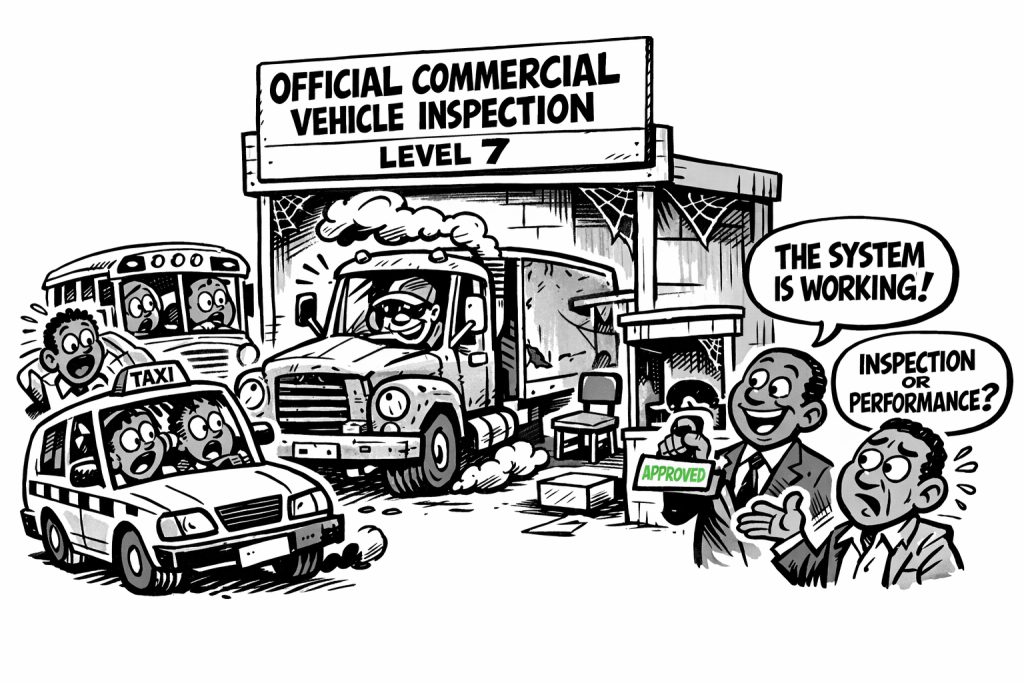
Historically speaking, one of the great mistakes small societies make is assuming that danger only announces itself in dramatic ways. We tend to fear the pothole we can see, the traffic jam we can curse, the broken road we can point to. But some of the most serious threats move quietly through the system, normalized by repetition, overlooked because they have become familiar. That is what this commercial vehicle inspection issue represents in the Virgin Islands.
Recent testimony before the Committee on Housing, Transportation, and Telecommunications revealed something deeply troubling: while public conversation has centered on road repairs and congestion, a more immediate danger has been traveling beside us all along. We are dealing with a safety vacuum in commercial vehicle oversight, and that vacuum is not theoretical. It is measurable.
Lieutenant Commander Alexander Moorehead of the Virgin Islands Police Department presented data showing that, across the last two years, out-of-service rates for commercial vehicles have remained near 20 percent. That phrase, “out of service,” is not administrative language without consequence. It means a vehicle has been found too dangerous to remain on the road.
Let us sit with that for a moment.
In Fiscal Year 2024, the out-of-service rate was 16.4 percent. In Fiscal Year 2025, it rose to 20.9 percent. In the first quarter of Fiscal Year 2026, it stood at 16.2 percent. In plain terms, that means roughly one in five commercial trucks inspected in this territory has been operating as a mechanical hazard. Not cosmetically flawed. Hazardous.
If you understand the past, you understand this pattern did not develop overnight. Across the Caribbean, and particularly in small island territories, enforcement systems often become strained by limited staffing, aging fleets, fragmented regulation, and the tendency to postpone preventative action until failure becomes impossible to ignore. What we are seeing now is the result of that long-standing institutional habit. We wait, and the risk matures.
And the danger here is not abstract. These inspections uncover failures in brakes, steering, fuel systems, and other core components that directly affect every driver, pedestrian, child, and commuter sharing the roadway. When a commercial truck is unsafe, the risk does not stay with the truck owner. It becomes public.
But the deeper concern is not merely the percentage of unsafe vehicles. It is the territory’s lack of certified capacity where it matters most.
The most alarming testimony may have been this: no one in the Virgin Islands is currently federally certified to conduct Level 7 inspections, the required jurisdictional inspections for high-capacity passenger vehicles such as school buses and taxis. That is not a small procedural gap. That is a structural failure in a category involving some of our most vulnerable passengers.
This didn’t start today. For years, many jurisdictions have treated compliance language as though it were secondary to day-to-day operations. But federal inspection systems are not casual frameworks. They are technical regimes with legal force behind them. The Virgin Islands must adhere to the North American Standard inspection levels, each of which serves a distinct function.
Level 1 is the full inspection, top to bottom, including the driver, the mechanical systems, and the underside of the vehicle. Level 2 is the walk-around inspection, focused on what can be observed without physically manipulating components. Level 3 deals with the driver’s credentials and administrative records, such as licensing, medical certification, and insurance. Level 4 is a special inspection aimed at one particular item or system. Level 5 is a vehicle-only mechanical inspection done at a yard or terminal rather than roadside. Level 6 applies to radioactive materials and is not currently performed in the territory. And then there is Level 7, the jurisdictionally mandated inspection reserved for school buses and taxis.
That final category matters because it exposes the limits of improvisation.
Bill 36-0109 seeks to modernize and streamline the Bureau of Motor Vehicles, and in principle, modernization is necessary. But modernization without certification is not reform. It is substitution. The VIPD has warned that allowing private certified garages to take on commercial inspections may create efficiency on paper while producing legal and safety problems in practice. Those garages may not have the federal authorization or specialized training required to conduct certain categories of inspection, especially Level 7.
And that matters because federal law is not flexible simply because a territory is under-resourced. If an inspection is performed by an entity that lacks the required certification under the Motor Carrier Safety Assistance Program, that inspection is invalid under Federal Motor Carrier Safety Administration oversight. Once that happens, the territory is no longer merely dealing with a local enforcement problem. It risks falling into direct conflict with federal standards, with possible consequences for highway safety funding and regulatory standing.
That is the broader lesson here. Institutions often convince themselves that partial compliance is better than no compliance. But in transportation safety, partial compliance can create a false sense of security more dangerous than open neglect. A bus may appear inspected. A taxi may appear cleared. A truck may appear roadworthy. But if the process behind that approval is invalid, then the public is not protected. It is misled.
So this issue must be understood for what it is. It is not just a bureaucratic technicality, and it is not simply a debate over who should inspect what. It is a test of whether the Virgin Islands intends to build a transportation safety system rooted in certified competence or continue relying on patchwork enforcement until tragedy forces urgency upon us.
Ensuring that commercial vehicles, school buses, and taxis are inspected by properly trained and federally certified professionals is not red tape. It is the basic architecture of public safety. And when that architecture is missing, the road does not forgive us.

Leave a Reply