
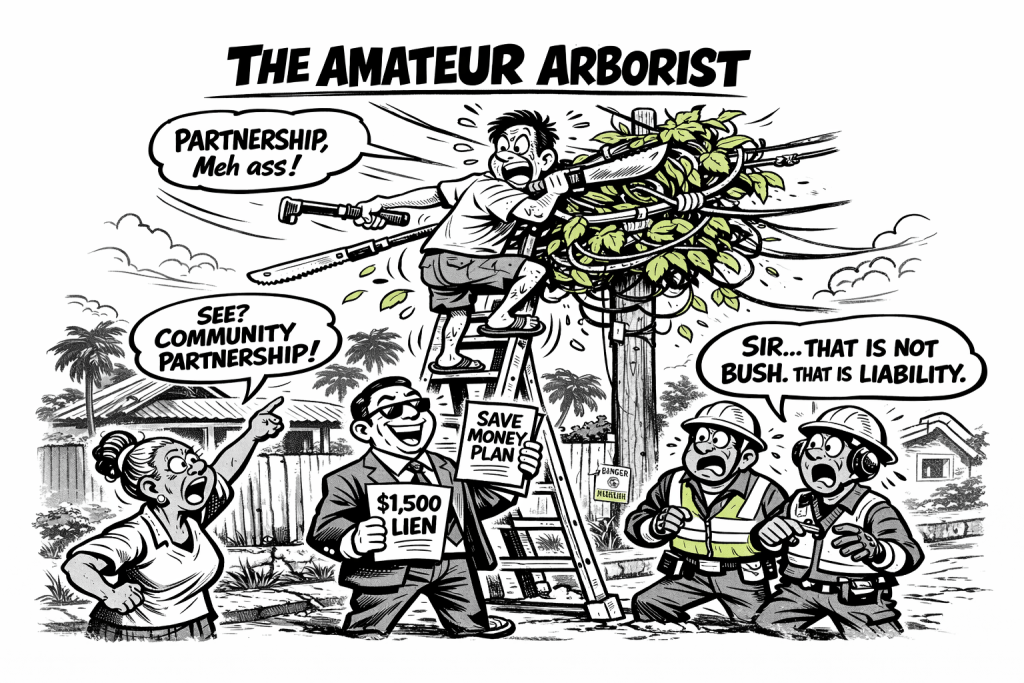
Let me tell you something: nothing starts a proper island argument faster than money, bushes, and who supposed to cut what by deh roadside.
Because what looked like a simple cleanup bill turned into a whole serious back-and-forth about safety, responsibility, and whether government trying to save money by handing regular people a problem bigger than it sound. Bill 36-00074, the Roadside Property Maintenance and Vegetation Act, came before lawmakers with one main idea: make private property owners responsible for clearing the overgrown vegetation next to public roads and utility lines.
Now on paper, some people hearing that and saying, “Well, that make sense. Clean up your property.” Be honest — plenty of folks does love the sound of “personal responsibility” until it come with chainsaw, power line, and one fine big enough to make you catch pressure.
Right now, the Department of Public Works handles roadside vegetation through private contracts, and they spending about $2.4 million a year doing it. So the bill’s supporters were basically saying, let us shift some of that burden, save some money, and make this thing more sustainable.
Sounds neat and tidy, right?
Well, not so fast.
Because tucked inside this whole plan was a $1,500 property tax lien for owners who fail to clear the brush. And baby, that is where the room started getting hot. Because now this ain’t just about trimming a little bush by the fence. Now this is about people trying to avoid a heavy penalty, and maybe taking on dangerous work they have no business doing in the first place.
That is where one of the strongest warnings came in. Steven Adams from VINGN brought up the image nobody could really ignore: the “amateur arborist.” And honestly? That phrase tell the whole story. You put a steep fine on people, and next thing you know, somebody cousin up on a ladder with one cutlass, one borrowed pole saw, and too much confidence.
And that is funny until it very much is not.
Because according to utility leaders, vegetation removal around cable and utility infrastructure is delicate work. Not yard-cleanup-on-a-Saturday work. Real technical work. The kind where one wrong cut could damage important systems and shift liability all over the place. So now, instead of saving money, you might be creating brand-new costs, brand-new headaches, and brand-new danger.
WAPA came in with the same energy, and rightly so. They made it clear that trimming near live power lines is specialized, high-risk work. Not “go outside and clean up the place” work. Not “send your nephew with gloves” work. We talking about energized lines, clearance zones, and real consequences. And when professionals start using words like electrocution, falling hazards, and debris injuries, that should be enough for everybody to pause and stop pretending this is just landscaping.
See, this is the part people like to skip. Folks hear “overgrown vegetation” and picture some tall grass and a little bush leaning over the road. But once utility lines enter the chat, this thing change character. Now the work needs training, equipment, judgment, and proper safety standards. And not everybody — especially elderly residents or people already stretched thin — has the strength, money, or support to manage that.
So then the financial side got just as messy.
Senator Ray Fonseca called the $1,500 lien punitive, and I can see why. When the minimum property tax bill is around $180, that lien start looking less like encouragement and more like punishment with paperwork. Critics said the bill could push vulnerable residents into delinquency, and from there, you already know how these things does snowball. One missed obligation turns into another, and before long, people fighting to hold on to property over roadside brush they were never physically or financially equipped to handle.
Now let me say this plain: nobody arguing against clean roadsides. Everybody want the roads safe, visible, and maintained properly. Nobody trying to defend wild bush swallowing up corners and utility poles. The real issue was whether this bill found the right balance, and from the sound of that hearing, plenty people felt it did not.
DPW supported the measure, saying it could create a more sustainable loop for maintenance funding. And okay, from a budget standpoint, you could see the appeal. But once the conversation shifted from cost savings to “who exactly is climbing up there near live wires?” the whole thing started looking shaky.
And that is why the bill failed in committee.
Because in the end, the worry over these so-called amateur arborists, the risk to infrastructure, and the severity of the fine proved too much to ignore. So for now, roadside vegetation management stays with the government, while the territory keeps trying to figure out how to keep the place clean without putting people in danger or pricing them into trouble.
I see this all the time: a policy idea sound reasonable until real life enter the room. And once real life show up, with old people, utility lines, tight budgets, and one ladder leaning too close to electricity, suddenly everybody remember that not every savings is worth the cost.

Leave a Reply