
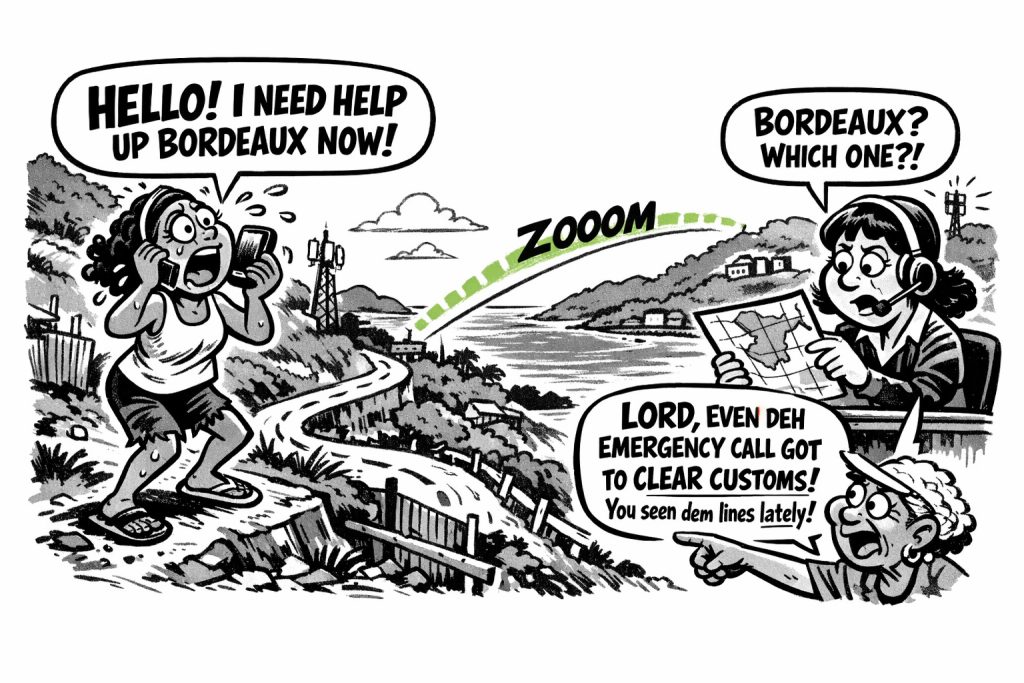
Listen to me, chile, when trouble reach your doorstep, the last thing anybody should have to worry about is whether help even know where you deh.
Imagine you in the middle of some real confusion up Bordeaux side or somewhere on deh North Side of St. Thomas. Your heart beating fast, you grab your phone, and you dial 911, believing plain and simple that somebody right here in the Virgin Islands gon answer. Somebody who know the roads, know the bends, know the landmarks, know where Miss Joyce shop used to be and where deh old church turnoff at. But instead of that, your call end up in Puerto Rico.
Now ain’t that something.
And no, this ain’t no little made-up story to frighten people. This is a real, documented problem affecting folks right here in the territory.
At a recent meeting of the Committee on Housing, Transportation, and Telecommunications, Dr. Gregory Guannel, who directs the Caribbean Green Technology Center at UVI, shared findings that shine a hard light on something dangerous happening with our cell service. What it shows is this: in certain parts of these islands, especially up high or in weak coverage areas, the phone not always staying loyal to local towers. Instead, it reaching out across the water and catching signal from Puerto Rico.
You know what the old people say: what sound close to you ain’t always what holding you.
That is where the danger step in. A cell phone does not just choose what make the most sense to us. It locks on to what it believes is the strongest or cleanest signal. So even if you standing right here in the Virgin Islands, your phone may ignore a nearby local tower and start pinging an antenna somewhere else. And if that somewhere else is Puerto Rico, then your emergency call gone out of jurisdiction before anybody here even know you need help.
That is no small thing.
Because when a 911 call gets routed to Puerto Rico, the person answering on the other end may not know our geography, our roads, or our communities. They do not have deh local authority to send out our police, fire, or ambulance. So now, instead of getting immediate help, your call has to find its way back where it belonged in the first place. And in a crisis, every second does count. A delay like that could mean the difference between rescue and regret.
Ain’t nothing new under the sun. We always paying the price when systems built for convenience get tested by real life.
Dr. Guannel and his team been studying this closely, using a special app to measure both signal power and signal quality across the islands. And that part important, because plenty people does look at their phone and see four bars and think everything good. But four bars don’t always mean a strong connection in the ways that matter. Sometimes the power look fine, but the quality weak. Interference, signal bounce over water, and other technical issues can make a phone behave in ways that put people at risk.
One of the most troubling parts of the research came from students themselves. Dr. Guannel shared that many students spoke about calling 911 and having those calls routed to Puerto Rico, leaving them unable to get police or emergency support when they needed it. So now the Center is trying to understand exactly which antennas these phones are pinging, and why the local towers are failing to catch those emergency signals when they should.
And that is the question, eh? Not whether the problem sound rare on paper, but whether it happening enough to put lives in danger.
Some carriers say these incidents are uncommon, or that it has to do with radio frequency behavior over water. But the data suggests that in places like Bordeaux and the North Side, this is not something people can just brush off and call occasional. This is a real concern, and it deserves real attention.
So as we wait for the next full update from the Caribbean Green Technology Center, let us be clear-eyed about what this means. Telecommunications in the Virgin Islands cannot just be about whether a signal shows up. It has to be about whether that signal holds steady when people need it most. Coverage alone is not enough. We need reliability. We need resilience. And most of all, we need to make sure that when somebody in this territory cries out for help, that call stays in these islands and reaches the hands meant to answer it.
Because mercy, when people dialing 911, they should not have to cross water before they find help.

Leave a Reply