
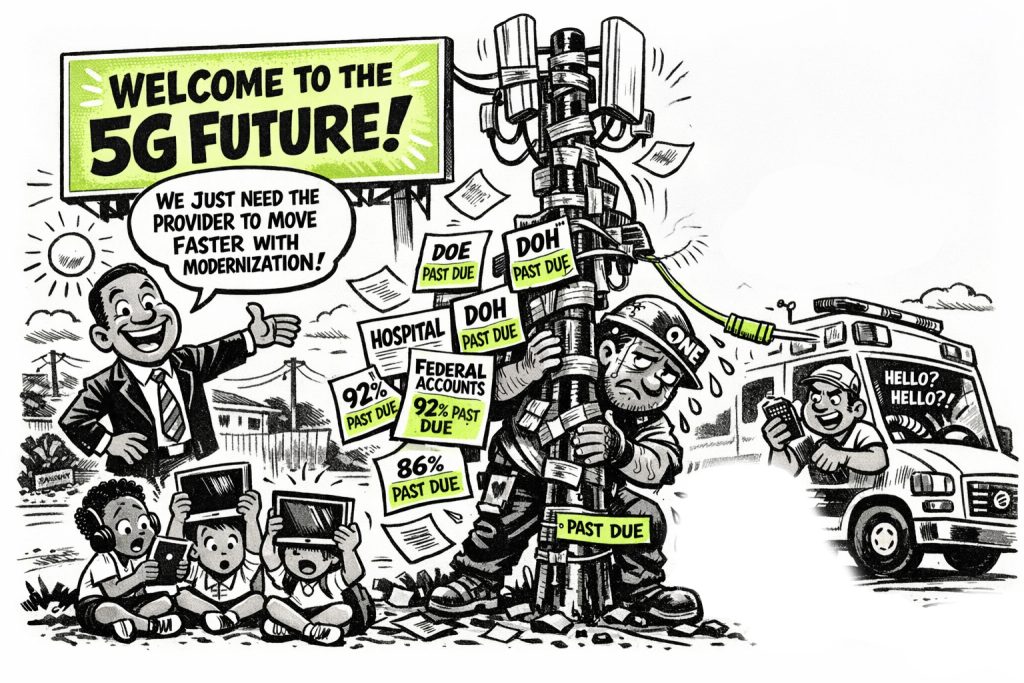
Historically speaking, infrastructure does not only fail because of storms, age, or geography. Sometimes it stalls because the same institutions asking for progress are the very ones starving it.
The Virgin Islands keeps talking about a “5G future” and full fiber connectivity like it is just a matter of technology catching up. But this situation is not really about towers and cables alone. This is also about debt, governance, and a long Caribbean habit of wanting modern systems without maintaining the financial discipline those systems require.
At the center of it is a hard truth: the Government of the Virgin Islands and its federal partners owe One Communications more than $7 million. That is not a small delay in paperwork. That is a structural burden. According to testimony from CEO Siobhan James Alexander before the Committee on Housing, Transportation, and Telecommunications, 92% of local government accounts are past due, along with 86% of federal accounts.
Now, if you understand the past, you understand why this matter so much. In small territories like ours, telecommunications is not some luxury line item. It is part of the backbone. Education depends on it. Healthcare depends on it. Emergency response depends on it. Commerce depends on it. So when major public entities like the Department of Education, the Department of Health, and the hospitals fall deep into arrears, they are not just owing a vendor. They are weakening a critical system the whole territory leaning on.
This didn’t start today. We have long lived with a contradiction in the Caribbean public sphere: government demands better service, the public demands modernization, but the institutions responsible for paying the bill move slow, fall behind, and then act surprised when growth stall. That is the real story here.
While lawmakers and residents are calling for faster speeds, stronger infrastructure, and broader 5G access, that same unpaid debt is creating what the company described as a serious cash flow problem. And cash flow, whether people like the phrase or not, is what determines whether upgrades happen now, later, or never. You cannot keep asking a provider to expand capacity, improve resilience, and compete in a modern market while tying up the very capital needed to do it.
There is a painful irony in all this. The Department of Education can come forward and speak honestly about the need for stronger connectivity for more than 10,000 students. That need is real. But if that same public system is part of the debt load preventing network expansion, then the government is not just describing the problem. It is participating in it.
What makes the situation even more telling is that One Communications has not cut off these agencies. They chose to keep service in place because they understand the role those institutions play in the life of the territory. That is not just business. That is a community decision. But goodwill is not an economic strategy, and patience is not infinite. As James Alexander made plain, this debt remains a major obstacle to progress.
At the end of the day, the Virgin Islands cannot talk seriously about digital transformation unless the government is prepared to behave like a reliable partner. Not just a regulator. Not just a hearing-holder. A partner. That means paying what it owes.
Because this $7 million is not only an accounting issue. It is a development issue. It is a public safety issue. It is an education issue. It is a healthcare issue. And until that is treated with the seriousness it deserves, the promise of a 5G future will remain what too many plans in this region become: a vision delayed by the old habits of the present.

Leave a Reply